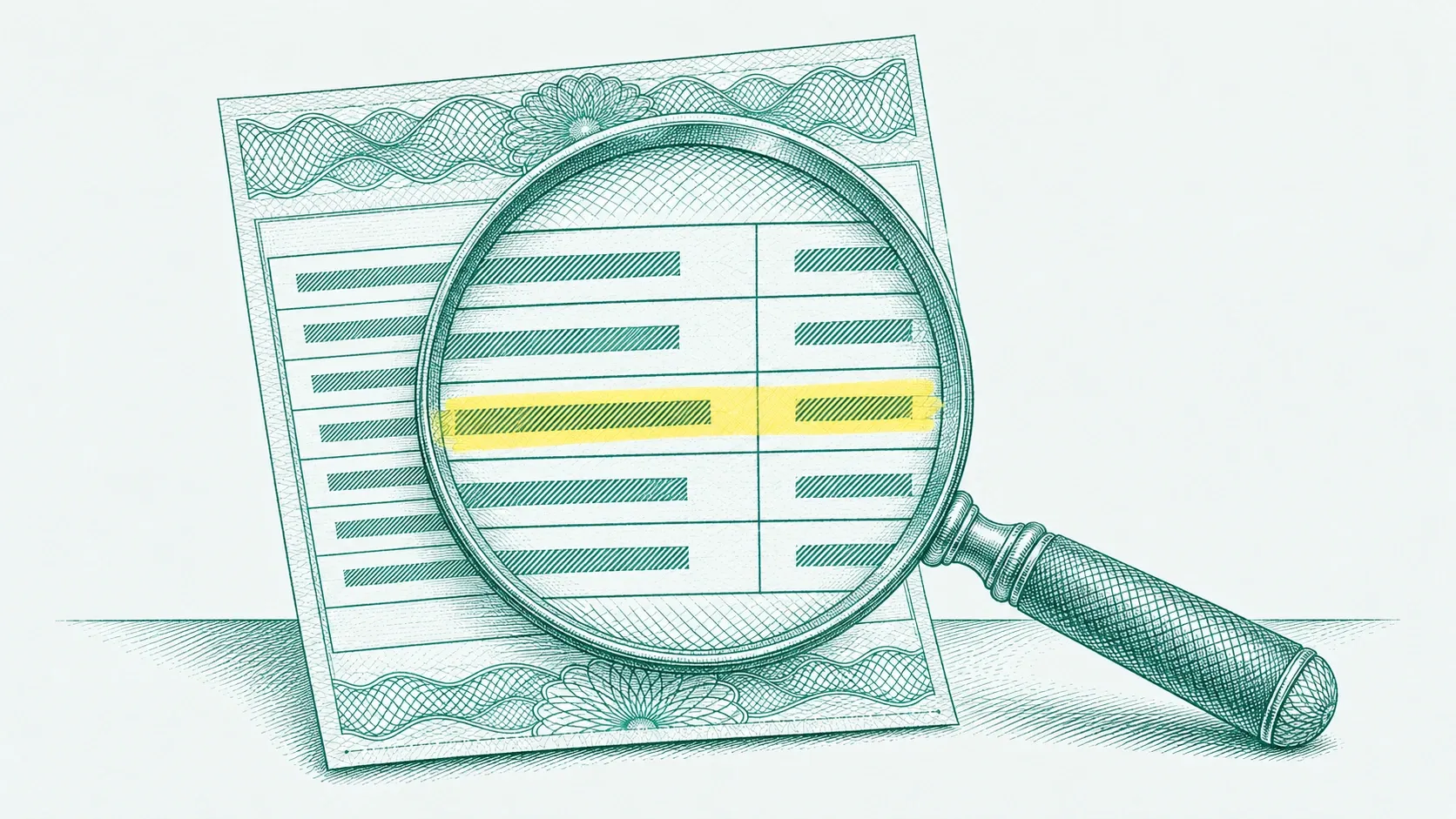
An example stub
This is check number 45 of 2026 for someone earning $65,000 a year in Illinois, paid weekly, who puts 5% into a 401(k), pays $42 a week for health insurance and $20 into an HSA. Labels vary by payroll company, so the common abbreviations are shown in the first column.
| Code | Description | This period | Year to date |
|---|---|---|---|
| Earnings | |||
| REG | Regular salary | $1,250.00 | $56,250.00 |
| Pre-tax deductions | |||
| 401K | 401(k) / 403(b) / 457 | $62.50 | $2,812.50 |
| MED125 | Health, dental & vision premiums | $42.00 | $1,890.00 |
| HSA | HSA (payroll) | $20.00 | $900.00 |
| Taxes | |||
| FIT | Federal income tax | $93.14 | $4,191.30 |
| OASDI | Social Security | $73.66 | $3,314.70 |
| MED | Medicare | $17.23 | $775.35 |
| IL SIT | Illinois income tax | $52.93 | $2,381.85 |
| NET | Net pay | $888.54 | $39,984.30 |
Federal taxable wages this period: $1,125.50. Social Security and Medicare wages: $1,188.00.
1. The header
The top of the stub shows the pay period (the dates you worked), the pay date (when the money arrives), your pay rate and often your hours. Many people are paid in arrears, so the check you get on Friday may cover the week before last.
2. Earnings
Gross pay is everything you earned before anything comes out: regular pay, overtime (OT), shift differentials, holiday or PTO pay, commissions and bonuses. Bonuses are often listed separately because they can be withheld at a flat rate. If you are hourly, check the hours and rate on each line.
3. Pre-tax deductions
These come out before income tax is figured, so each dollar costs you less than a dollar of take-home. In the example, the $62.50401(k) deferral lowers federal and Illinois taxable wages but not Social Security and Medicare wages. Health premiums and HSA contributions through a cafeteria plan lower all three. A few states don’t follow the federal rules: California and New Jersey tax HSA contributions, and Pennsylvania taxes 401(k) deferrals. See which deductions lower which taxes.
4. Taxes
- Federal income tax (FIT, FITW): figured from your W-4 with the IRS percentage method. It changes with every pay change.
- Social Security (OASDI, SS): 6.2% of Social Security wages, until you have earned $184,500 from this employer in 2026.
- Medicare (MED, FICA-HI): 1.45% of all wages, plus 0.9% Additional Medicare on wages over $200,000 from one employer.
- State income tax (SIT, SWT): your state’s own formula. Nine states have none.
- Local taxes: city, county or school district taxes such as NYC, Philadelphia, Ohio cities, Maryland and Indiana counties, and Pennsylvania EIT and LST.
- State programs: disability and paid leave premiums such as CA SDI, NY PFL and DBL, NJ TDI and FLI, WA PFML and WA Cares.
5. After-tax deductions
Roth 401(k) contributions, union dues, voluntary supplemental life or disability insurance, wage garnishments and charitable payroll gifts come out after taxes. They lower take-home dollar for dollar.
6. Net pay and year-to-date totals
Net pay is what is deposited. The YTD column adds every check since January 1. Watch it late in the year: once Social Security wages reach $184,500, that deduction stops and checks get bigger. Your final YTD figures feed your W-2.
7. Employer-paid items
Some stubs list employer contributions (401(k) match, the employer share of health premiums, employer FICA). They are shown for information; they do not reduce your pay.
Rebuild your own stub with the calculator and expand any line to see exactly how it was figured.
Frequently asked questions
What does FICA mean on my pay stub?
FICA is the Federal Insurance Contributions Act: Social Security (6.2%, sometimes labeled OASDI) and Medicare (1.45%, sometimes MED or FICA-HI). Your employer pays a matching amount that does not come out of your check.
Why is my federal taxable wage lower than my gross pay?
Pre-tax deductions such as a traditional 401(k), health premiums and HSA contributions are subtracted before federal income tax is figured. Social Security and Medicare wages are often higher, because 401(k) deferrals are still subject to FICA.
What are YTD amounts?
Year-to-date totals add up every paycheck since January 1. Compare the final YTD figures with your W-2; they should match after accounting for pre-tax deductions.
What should I do if a deduction looks wrong?
Check your W-4 and state form with HR or your payroll portal first. Most errors come from an outdated W-4, a benefit election that started late, or the wrong work location for local taxes.